---
title: Wheelchair Alliance FAQ's Wheelchair Users
description: Wheelchair Alliance FAQ's Wheelchair Users
---
[Skip to Content](https://www.wheelchair-alliance.co.uk/wheelchair-alliance-faqs-wheelchair-users#body)
[Donate](https://www.wheelchair-alliance.co.uk/wheelchair-alliance-donate?hsLang=en)
[](https://www.wheelchair-alliance.co.uk?hsLang=en)
[Become a Member](https://www.wheelchair-alliance.co.uk/wheelchair-alliance-wheelchair-users-membership-sign-up?hsLang=en)
[](https://www.wheelchair-alliance.co.uk?hsLang=en)
Menu
- [HOME](https://www.wheelchair-alliance.co.uk?hsLang=en)
- THE ALLIANCE
- [THE WHEELCHAIR COLLECTIVE](https://www.wheelchair-alliance.co.uk/wheelchaircollective?hsLang=en)
- [SUPPORTERS](https://www.wheelchair-alliance.co.uk/wheelchair-alliance-partners?hsLang=en)
- [ABOUT US](https://www.wheelchair-alliance.co.uk/wheelchair-alliance-about-us?hsLang=en)
- [REPORTS](https://www.wheelchair-alliance.co.uk/wheelchair-alliance-reports?hsLang=en)
- [ALL-PARTY PARLIAMENTARY GROUP](https://www.wheelchair-alliance.co.uk/all-partyparliamentarygroup?hsLang=en)
- [INNOVATION SIG](https://www.wheelchair-alliance.co.uk/innovation-special-interest-group?hsLang=en)
- [CONTACT](https://www.wheelchair-alliance.co.uk/wheelchair-alliance-contact?hsLang=en)
- [ACADEMY](https://www.wheelchair-alliance.co.uk/academy?hsLang=en)
- [NEWS](https://www.wheelchair-alliance.co.uk/blog?hsLang=en)
- [Become a Member](https://www.wheelchair-alliance.co.uk/wheelchair-alliance-wheelchair-users-membership-sign-up?hsLang=en)
- [Donate](https://www.wheelchair-alliance.co.uk/wheelchair-alliance-donate?hsLang=en)
[Skip Navigation](https://www.wheelchair-alliance.co.uk/wheelchair-alliance-faqs-wheelchair-users#after-page-nav)
- [How do I get a wheelchair?](https://www.wheelchair-alliance.co.uk/wheelchair-alliance-faqs-wheelchair-users#anchor-1)
- [How is my wheelchair funded?](https://www.wheelchair-alliance.co.uk/wheelchair-alliance-faqs-wheelchair-users#anchor-2)
- [What about insurance and travel?](https://www.wheelchair-alliance.co.uk/wheelchair-alliance-faqs-wheelchair-users#anchor-3)
- [What am I entitled to?](https://www.wheelchair-alliance.co.uk/wheelchair-alliance-faqs-wheelchair-users#anchor-4)
- [What does accessibility mean?](https://www.wheelchair-alliance.co.uk/wheelchair-alliance-faqs-wheelchair-users#anchor-5)
- [What else do I need to know?](https://www.wheelchair-alliance.co.uk/wheelchair-alliance-faqs-wheelchair-users#anchor-6)
## FAQs for Wheelchair Users
How do I get a Wheelchair?
###### Introduction: The information in this section explains who can refer you for a wheelchair, the existence of eligibility criteria and the importance of assessment by experts. Poorly fitting wheelchairs can cause serious problems but getting the right wheelchair can enable and give you more independence and comfort.
Will I need an assessment, or can I simply get one that I think I would like?
- We would always say that it is vitally important to have an assessment by a person who is an expert in wheelchairs and postural management, whether that be provided thought the NHS or through a private retailer.
- Why is this important? A wheelchair that is the wrong size or does not support you correctly can lead to serious problems such as pressure sores.
Will I automatically get a wheelchair?
- Your referral (see below) will be screened by the service that receives it and if you do not meet their eligibility criteria, you will be advised that you do not qualify for an NHS wheelchair. The criteria can vary depending on where you live.
- If you are being assessed by an NHS funded wheelchair service, you will discuss your needs and current condition with the team. Together you will consider your possible future needs and then, you will have a wheelchair prescribed
If you do not fit the eligibility criteria you will have a number of possible options open to you such as buying a wheelchair yourself (please remember you will need to have an assessment to get the right fit), approaching a local or national charity for full or part funding or possibly contacting organisations such as Access to Work (see ‘How is my wheelchair funded’ for more information)
How do I find out what the eligibility criteria are in my area?
Each wheelchair service should clearly show their eligibility criteria on their website. If you are unable to access this information, it should be sent to you.
Will the NHS supply my wheelchair?
If you struggle to walk or are disabled you may be able to get a wheelchair from the**[NHS](https://www.nhs.uk/conditions/social-care-and-support-guide/care-services-equipment-and-care-homes/walking-aids-wheelchairs-and-mobility-scooters/)**.
- If this is your first wheelchair, speak to your GP or other health care professional as they will need to refer you to your local wheelchair service. If not, you can self-refer if your situation has changed and you need to have a review.
- If you have been referred by an accredited therapist, or if you have a telephone assessment, a basic manual wheelchair may be issued directly to you
- If you meet the eligibility criteria for your local area, you may have a telephone or virtual assessment and be issued a wheelchair directly. For more complex situations you will have a full assessment either in the clinic/your home/your work/place of education and discuss with your therapist which wheelchair/s will best suit the needs you have agree
- You will be sent an appointment, and the wheelchair therapist will discuss with you your condition, how the wheelchair can meet your needs, how long you need to use it each day, and how it might help you achieve your goals.
- Your wheelchair will be ordered from a range of wheelchairs that are available to NHS services. If, after a conversation with your therapist, you decide you need a different wheelchair or accessory from the one prescribed, you may be offered a Personal Wheelchair Budget (see ‘How is my wheelchair funded’ for more information)
- You may need another appointment to ensure that the armrests, footplates and other elements of the wheelchair are adjusted to best support you. ( However, these may be already set according to the measurements taken at your assessment or alternatively, an approved repairer may adjust your wheelchair.)
- Your therapist will show you how to use your wheelchair and talk about the repair and maintenance that is necessary with the relevant contact numbers
- You may be given a follow up appointment or advised to call if your condition changes
The wheelchair will be on loan to you from your local wheelchair service. They will be responsible for maintenance and repair of our wheelchair. You may need to think about insurance, especially if you have a powered wheelchair (see ‘What about insurance and travel’ for more information). The Wheelchair Alliance has produced a **[Wheelchair Charter](https://www.wheelchair-alliance.co.uk/wheelchair-alliance-charter?hsLang=en)**which may help guide you in the conversations you have with your wheelchair service during the different steps to getting the right wheelchair.
What if I want to buy my own wheelchair?
If you decide to buy your own wheelchair, look for a reputable retailer that sells disability equipment and ensure they have a qualified wheelchair therapist (either an occupational therapist or physiotherapist) who can assess you and give you support in choosing the right wheelchair for your needs. The retailer may be a member of the British Healthcare Trades Association and adhere to their guidance. It is important to remember that you will own the wheelchair and therefore be responsible for the cost of all repairs and maintenance. Once again you may need to think about insurance.
Where can I find more information about types of wheelchairs and how to access one?
There are many websites that have information about how to get a wheelchair such as:
**[How to get a wheelchair | Disability charity Scope UK](https://www.scope.org.uk/advice-and-support/wheelchairs)**
How is my wheelchair funded?
###### Introduction: There are several ways a wheelchair may be funded. You may have one on loan, you may be provided with a Personal Wheelchair Budget, you may get some additional funding from a charity or you may choose to buy your own wheelchair. This may all seem rather confusing and the following information will explain these different options and important things to consider.
Exactly how is my wheelchair funded?
Once you have had the all-important assessment to identify the dimensions and type of wheelchair you need, the way it will be paid for will be the next consideration. There is a huge variation in the cost with a standard wheelchair costing just over £150 to over £20,000 for wheelchairs with the latest technological features. Many people do not have the disposable income to pay for very expensive equipment and the following information highlights the choice you may have through the NHS. The words used to describe the funding choice can be confusing and the following explanations and links may help. *It should be noted that the Wheelchair Alliance disclaimer covers all links within our FAQs unless the link is to an area within our own site, such as our newsletters or reports.*
NHS England says the following about personal wheelchair budgets (PWBs), which should have replaced the voucher scheme offered by NHS provided wheelchair services:
A personal wheelchair budget is a resource available to support people’s choice of wheelchair, either within services provided by via the NHS or used outside of NHS provided services (e.g a private retailer). Personal wheelchair budgets enable postural and mobility needs to be included in wider care planning and can support people to access a wider choice of wheelchair.
With a personal wheelchair budget, wheelchair users should expect to have:
- a personalised assessment where they are supported to identify the health and wellbeing outcomes they wish to achieve (these are the goals you agree to enable you to perform tasks and activities at home, work, place of education and leisure)
- a care plan which captures the health and wellbeing outcomes identified, which may be part of any wider care plans the person requires for their care, for example an Education, Health and Care (EHC) plan
- care that is better integrated, meaning that different agencies work together to support their postural and mobility needs and achieve their health and wellbeing outcomes
- information provided upfront about the amount of money available in their personal wheelchair budget and the options available to them locally to use it
- information about the repair and maintenance of wheelchairs, if the option to purchase a wheelchair outside of the NHS commissioned service is taken.
Since 2 December 2019, people who access wheelchair services, whose posture and mobility needs impact their wider health and social care needs, have a legal right to a personal wheelchair budget.
The legal right covers people who are referred or already registered and meet the eligibility criteria of their local wheelchair service, when they require a new wheelchair either through a change in clinical needs or in the condition of the current chair.
The NHS site also answers some of the **[questions](https://www.england.nhs.uk/personalisedcare/personal-health-budgets/personal-wheelchair-budgets/frequently-asked-questions/#how-much-money-will-people-get-in-their-personal-wheelchair-budget)** you may have. There are other resources available too, such as those written by the British Healthcare Trade Association **([BHTA](https://issuu.com/bhta/docs/gw_20pwb_20v2?fr=sYmM2OTIyMTk4NzU)**), as well as resources provided by local wheelchair services, either directly provided such as those in **[Leeds](https://flipbooks.leedsth.nhs.uk/LN004044.pdf),** or **[services provided for the NHS](https://www.bhta.com/personal-wheelchair-budgets-an-introduction-to-using-your-nhs-wheelchair-funding/)** by private companies (NHS commissioned services), such as those on **[Cambridgeshire and Peterborough](https://cambridgeshireandpeterborough.wheelchair.services/personal-wheelchair-budgets/)** or in **[Kent and Medway](https://rosscare.co.uk/pages/personal-wheelchair-budget-overview)**. Searching online for your local wheelchair service will provide the information relevant to you.
At a glance the following diagram shows the different options available:
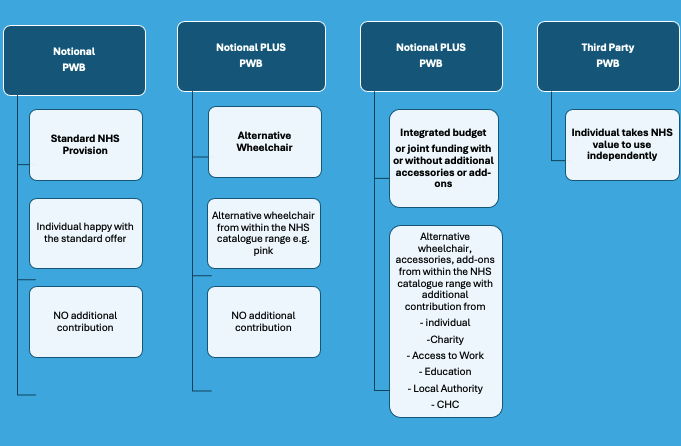
**A Notional PWB:**
This is the standard NHS provision. The wheelchair is on loan from the NHS wheelchair service and they are responsible for ongoing repair and maintenance. You will not be expected to contribute anything towards your wheelchair, although you may want to think about additional insurance (see ‘What about insurance and travel?’ section)
**A Notional plus PWB:**
Following assessment, you may discuss an alternative wheelchair that suits your agreed needs with your therapist. If the alternative wheelchair is from the NHS ‘catalogue’ range this may be provided at no additional cost to you.
Following assessment, you may wish to discuss an alternative wheelchair that has additional features or ‘add-ons’ that you would like and which are still included in the NHS ‘catalogue’. These will have an additional cost which can be contributed to by yourself, through joint funding (NHS, Continuing Health Care budget, Local Authority, Education, Access to Work for example) or through a charity. You should remember that you may be responsible for the repair, maintenance and insurance of these additional features and it is important to discuss this with your wheelchair service before making your final decision.
**A Third party PWB:**
The value of the wheelchair that would have been provided to you by the NHS, is available for you to use to purchase your wheelchair through an independent provider. The wheelchair must meet your assessed needs for the funding to be released. It is important to know that wheelchairs on the NHS catalogue might be less expensive than those from an independent supplier, as that company has to cover other costs to deliver a service. Your budget will cover some costs for repair and maintenance but check what isn’t included and look into insurance too.
What about insurance and travel?
###### Introduction: Standard wear and tear is expected with your wheelchair and if your wheelchair is on loan from the NHS through a notional or notional plus PWB (for more information about PWB's please read the answer to the FAQ "How exactly is my wheelchair funded" in the FAQ section above "How do I get a wheelchair?") you will be advised when your wheelchair is due for a maintenance check or who to contact if a repair is needed. If you have received a budget for additional features, it is important that you ask your wheelchair service whether repair and maintenance of the additions are covered – this may be unlikely. It is therefore important to think about insurance, whether you use a manual or powered wheelchair.
So how do I insure my wheelchair??
Your wheelchair is vital to your independence and freedom. Ensuring it is well maintained is important to your safety and also to those around you. It is important that you are using your wheelchair within your limits – there is also a **‘[Highway code’](https://www.bhta.com/using-electric-scooters-and-wheelchairs-a-highway-code-for-users/)** for wheelchair users that may provide useful information in addition to that supplied by your wheelchair service. You may need to consider insurance cover for
- Accidental damage, vandalism or theft
- Hire for an alternative wheelchair following an insured event
- Public liability (where using your wheelchair results in accidental damage to a person or property)
- International travel
There are many companies that provide cover for wheelchairs and it is important that you look at a few different options to compare the cost of the insurance policy, the excess and what is and isn’t included. Here are a few links, however there are many more you may find. The Wheelchair Alliance stresses that it does not endorse any one provider, so these are not recommendations, simply examples:
**[Blue Badge Motability Insurance](https://www.bluebadgemobilityinsurance.co.uk/wheelchair-insurance)**
**[Review Mobility Insurance](https://reviewmobility.co.uk/wheelchair-insurance/)**
**[Surewise](https://www.surewise.com/wheelchair-insurance/)**
**[Mark Bates](https://markbatesltd.com/schemes/manual-wheelchair)**
What if I want to travel with my wheelchair?
Wheelchair users travel all over the world. It is important to be well prepared before you travel and there are some useful resources that provide hints and tips such as
**‘[Get Wise to Flying with a disability’](https://issuu.com/bhta/docs/gw_tfwd_2020?fr=sNjg3NjIzMDg5ODU),**
**‘[Disability and travel abroad’](https://www.gov.uk/government/publications/disabled-travellers/disability-and-travel-abroad)**
**‘[Travelling with mobility and medical equipment’](https://www.caa.co.uk/passengers/prm/travelling-with-mobility-and-medical-equipment/),** which has a useful video explain top tips for air travel with a powered wheelchair.
What am I entitled to?
###### Introduction: There is a lot to consider when thinking about what a person is entitled to. Each person will have unique circumstances therefore anything mentioned in this FAQ may be relevant to one individual and/or their family but not to another.
What are my fundamental entitlements??
As the Wheelchair Alliance focuses on getting the right wheelchair at the right time it is useful to know that this is underpinned by some fundamental legislation such as, but not limited to,:
- The Convention on the Rights of Persons with Disabilities and other rights-based frameworks including the Convention on the Rights of the Child which recognises that personal mobility and access to an appropriate wheelchair is a human right
- **[The Disability Rights and Equality Act 2010](https://www.gov.uk/browse/disabilities/rights)**
- **[Disability Discrimination Act 2005](https://assets.publishing.service.gov.uk/government/uploads/system/uploads/attachment_data/file/228870/9780108508066.pdf)**
What about other entitlements?
Having a disability may entitle you or your primary carer to certain benefits. The Wheelchair Alliance is not able to provide information in this area as each person’s circumstances, and therefore their entitlements, differ.
You can get guidance from the [**Government website**](https://www.gov.uk/browse/benefits/disability) which shows the different financial benefits that may be available to disabled people. Your local Citizen’s Advice centre may give you face to face support or you can go**[online for more information](https://www.citizensadvice.org.uk/benefits/sick-or-disabled-people-and-carers/benefits-for-people-who-are-sick-or-disabled/).**
There is a lot of information available on sites such as:
- **[Sense](https://www.sense.org.uk/information-and-advice/benefits-and-money/benefits-and-financial-help-if-youre-a-disabled-adult/)**
- **[MND Association](https://www.mndassociation.org/support-and-information/information-resources/useful-organisations-and-internet-sites)**
- [**Disability Rights UK**](https://www.disabilityrightsuk.org/resources/resources-index)
What does accessibility mean?
###### Introduction : There are many different barriers to accessibility including communication, physical, political, policy, programmatic, social and transportation which are described in a House of Lords paper published in May 2024.
This section of the FAQs is under development and if you have thoughts on what should be included please complete the [**contact form**](https://www.wheelchair-alliance.co.uk/wheelchair-alliance-contact?hsLang=en)
What else do I need to know?
###### There are a great many questions that may not have been covered in the other sections. If there are mistakes or gaps, we would like to hear about them, as well as your ideas for other sites that are useful or new FAQs we could develop.
Your comments can be sent to us via our **[contact form](https://www.wheelchair-alliance.co.uk/wheelchair-alliance-contact?hsLang=en)**
What action could you take if something isn’t right with your wheelchair or its provision?
Some wheelchair users and their families may experience problems relating to their wheelchair. These could include issues such as
- Being referred to a wheelchair service
- Getting the right wheelchair
- Getting your wheelchair repaired
- Delays in getting any problems resolved
- How to make suggestions for improvements
The first four points should be resolved by talking the issue through with your wheelchair service directly. They may also have a Wheelchair User Forum that you could attend, especially to make suggestions about service wide improvements or developments that could be considered. If they don’t have a Wheelchair User Forum, do ask why not! Even if they don’t have a forum, this doesn’t mean the Wheelchair Service isn’t collecting feedback e.g. through satisfaction surveys so it is worth emailing them. If you don’t know where your local NHS wheelchair service is, you can ask your GP or look at the NHS directory of local services to help you. If you decided to buy a wheelchair through an independent retailer, then you should talk the problem through with them in the first instance.
However, despite talking directly with the wheelchair service provider, you may find your problem isn’t resolved. What do you do then?
We hope that the following step by step approach will help you.
1. Identify exactly what your issue is, with any supporting dates and evidence. Being specific helps to resolve your problem.
2. Contact the local wheelchair service provider who gave you your wheelchair to discuss the issue directly.
3. If you do not get a reply, ask the wheelchair service provider for an update on the situation and if you are unhappy with the response, raise a formal written complaint.
4. If your problem still isn’t resolved contact your local Integrated Care Board (ICB). An ICB is the organisation that develops plans, funds and awards contracts for the health services in your area. The following link may help you find the right ICB**[Find your local integrated care board (ICB) - NHS (www.nhs.uk)](https://www.nhs.uk/nhs-services/find-your-local-integrated-care-board/)#**
The person in the ICB who commissions the wheelchair service will be unable to deal with individual service users’ issues as they do not have access to the relevant notes. However, they are responsible for ensuring your wheelchair service provider delivers the service commissioned. They will expect the wheelchair service provider to have communicated any risks and issues to them in a timely manner and that remedial action plans are in place as and when appropriate.
1. If your wheelchair was provided by the NHS, you may also want to contact the NHS service via the Patient Advocacy and Liaison Service (PALS) which considers patient experience and complaints. Details of how to contact PALS will be on the local NHS website.
2. Healthwatch is another local service who may be interested in knowing about the situation.
3. If none of these options resolve your situation, you may consider contacting the **[Health Ombudsman](https://www.ombudsman.org.uk/)**
4. Your experience of your wheelchair service and of using a wheelchair is extremely valuable and joining the local wheelchair user group or forum will help to influence service improvements. ***You can also leave information by clicking on this link to our website***
What if I have a problem with a wheelchair I have purchased privately?
If you decide to buy a wheelchair privately you may find the British Healthcare Trade Association publications useful. They have a code of Code of Practice which companies registered with them should abide by. These can be found on their website **[Code of Practice doc – first draft: 15 April 2002 (bhta.com)](https://www.bhta.com/wp-content/uploads/2020/09/BHTA-Code-of-Practice-1-January-2018.pdf)**. There is also a useful publication called ‘Get wise to accessing a wheelchair or mobility scooter**[GW-NAWMS-15.pdf (bhta.com)](https://www.bhta.com/wp-content/uploads/2019/10/GW-NAWMS-15.pdf)**
- [Home](https://www.wheelchair-alliance.co.uk/home)
- [Wheelchair Users](https://www.wheelchair-alliance.co.uk/wheelchair-alliance-wheelchair-users)
- [Commissioners & Providers](https://www.wheelchair-alliance.co.uk/wheelchair-service-commissioners-providers)
- [The Alliance](https://www.wheelchair-alliance.co.uk/wheelchair-alliance-about-us)
- [Wheelchair Charter](https://www.wheelchair-alliance.co.uk/wheelchair-alliance-charter)
- [Reports](https://www.wheelchair-alliance.co.uk/wheelchair-alliance-reports)
- [FAQ's](https://www.wheelchair-alliance.co.uk/wheelchair-alliance-main-faq)
- [Supporters](https://www.wheelchair-alliance.co.uk/wheelchair-alliance-partners)
- [News](https://www.wheelchair-alliance.co.uk/blog)
- [Contact Us](https://www.wheelchair-alliance.co.uk/wheelchair-alliance-contact)
[](https://www.facebook.com/WheelchairAlliance) [](https://www.linkedin.com/company/wheelchair-alliance/)
**Wheelchair Alliance Community Interest Company | Registered number: 13761260**
In November 2021, the Wheelchair Alliance became a Community Interest Company. This is a special type of company which exists to benefit a specific community, namely the community of wheelchair users in England. We took this important step so that we could look for sponsors to help us achieve what we have set out to do in our strategy. All the Board Members of the Wheelchair Alliance volunteer their time, however we do have to fund things such as your website, some administrative support and project work which gathers evidence helping us lobby for change. There are no shareholders in the company, and should there be any profit it is ploughed back into making a difference for the wheelchair community on a national level.
All rights reserved.
Disclaimer: *To support wheelchair users in finding the information they are looking for, The Wheelchair Alliance will at times provide links to websites that we believe may be of interest. The Wheelchair Alliance does not endorse any particular organisation, service or product that may be advertised on third party websites. The Wheelchair Alliance assumes no responsibility or liability for any errors or omissions in the content of these third party websites.*
*Address: 167-169 Great Portland Street,
London,
W1W 5PF*
*email: admin@wheelchair-alliance.co.uk*
[Privacy Policy |](https://144566510.hs-sites-eu1.com/wheelchair-alliance-privacy-policy?hsLang=en)[Our Policies](https://144566510.hs-sites-eu1.com/wheelchair-alliance-our-policies?hsLang=en)
♥ Made with Care for the Wheelchair Alliance
```json
{
"@context" : "https://schema.org",
"@type" : "FAQPage",
"mainEntity" : [ {
"@type" : "Question",
"acceptedAnswer" : {
"@type" : "Answer",
"text" : "\n- We would always say that it is vitally important to have an assessment by a person who is an expert in wheelchairs and postural management, whether that be provided thought the NHS or through a private retailer.
\n- Why is this important? A wheelchair that is the wrong size or does not support you correctly can lead to serious problems such as pressure sores.
\n
"
},
"name" : "Will I need an assessment, or can I simply get one that I think I would like?"
}, {
"@type" : "Question",
"acceptedAnswer" : {
"@type" : "Answer",
"text" : "\n- Your referral (see below) will be screened by the service that receives it and if you do not meet their eligibility criteria, you will be advised that you do not qualify for an NHS wheelchair. The criteria can vary depending on where you live.
\n- If you are being assessed by an NHS funded wheelchair service, you will discuss your needs and current condition with the team. Together you will consider your possible future needs and then, you will have a wheelchair prescribed
\n
\nIf you do not fit the eligibility criteria you will have a number of possible options open to you such as buying a wheelchair yourself (please remember you will need to have an assessment to get the right fit), approaching a local or national charity for full or part funding or possibly contacting organisations such as Access to Work (see ‘How is my wheelchair funded’ for more information)
"
},
"name" : "Will I automatically get a wheelchair?"
}, {
"@type" : "Question",
"acceptedAnswer" : {
"@type" : "Answer",
"text" : "Each wheelchair service should clearly show their eligibility criteria on their website. If you are unable to access this information, it should be sent to you.
"
},
"name" : "How do I find out what the eligibility criteria are in my area?"
}, {
"@type" : "Question",
"acceptedAnswer" : {
"@type" : "Answer",
"text" : "If you struggle to walk or are disabled you may be able to get a wheelchair from the NHS.
\n\n- If this is your first wheelchair, speak to your GP or other health care professional as they will need to refer you to your local wheelchair service. If not, you can self-refer if your situation has changed and you need to have a review.
\n- If you have been referred by an accredited therapist, or if you have a telephone assessment, a basic manual wheelchair may be issued directly to you
\n- If you meet the eligibility criteria for your local area, you may have a telephone or virtual assessment and be issued a wheelchair directly. For more complex situations you will have a full assessment either in the clinic/your home/your work/place of education and discuss with your therapist which wheelchair/s will best suit the needs you have agree
\n- You will be sent an appointment, and the wheelchair therapist will discuss with you your condition, how the wheelchair can meet your needs, how long you need to use it each day, and how it might help you achieve your goals.
\n- Your wheelchair will be ordered from a range of wheelchairs that are available to NHS services. If, after a conversation with your therapist, you decide you need a different wheelchair or accessory from the one prescribed, you may be offered a Personal Wheelchair Budget (see ‘How is my wheelchair funded’ for more information)
\n- You may need another appointment to ensure that the armrests, footplates and other elements of the wheelchair are adjusted to best support you. ( However, these may be already set according to the measurements taken at your assessment or alternatively, an approved repairer may adjust your wheelchair.)
\n- Your therapist will show you how to use your wheelchair and talk about the repair and maintenance that is necessary with the relevant contact numbers
\n- You may be given a follow up appointment or advised to call if your condition changes
\n
\nThe wheelchair will be on loan to you from your local wheelchair service. They will be responsible for maintenance and repair of our wheelchair. You may need to think about insurance, especially if you have a powered wheelchair (see ‘What about insurance and travel’ for more information). The Wheelchair Alliance has produced a Wheelchair Charter which may help guide you in the conversations you have with your wheelchair service during the different steps to getting the right wheelchair.
"
},
"name" : "Will the NHS supply my wheelchair?"
}, {
"@type" : "Question",
"acceptedAnswer" : {
"@type" : "Answer",
"text" : "If you decide to buy your own wheelchair, look for a reputable retailer that sells disability equipment and ensure they have a qualified wheelchair therapist (either an occupational therapist or physiotherapist) who can assess you and give you support in choosing the right wheelchair for your needs. The retailer may be a member of the British Healthcare Trades Association and adhere to their guidance. It is important to remember that you will own the wheelchair and therefore be responsible for the cost of all repairs and maintenance. Once again you may need to think about insurance.
"
},
"name" : "What if I want to buy my own wheelchair?"
}, {
"@type" : "Question",
"acceptedAnswer" : {
"@type" : "Answer",
"text" : "There are many websites that have information about how to get a wheelchair such as:
\nHow to get a wheelchair | Disability charity Scope UK
"
},
"name" : "Where can I find more information about types of wheelchairs and how to access one?"
} ]
}
```
```json
{
"@context" : "https://schema.org",
"@type" : "FAQPage",
"mainEntity" : [ {
"@type" : "Question",
"acceptedAnswer" : {
"@type" : "Answer",
"text" : "Once you have had the all-important assessment to identify the dimensions and type of wheelchair you need, the way it will be paid for will be the next consideration. There is a huge variation in the cost with a standard wheelchair costing just over £150 to over £20,000 for wheelchairs with the latest technological features. Many people do not have the disposable income to pay for very expensive equipment and the following information highlights the choice you may have through the NHS. The words used to describe the funding choice can be confusing and the following explanations and links may help. It should be noted that the Wheelchair Alliance disclaimer covers all links within our FAQs unless the link is to an area within our own site, such as our newsletters or reports.
\nNHS England says the following about personal wheelchair budgets (PWBs), which should have replaced the voucher scheme offered by NHS provided wheelchair services:
\nA personal wheelchair budget is a resource available to support people’s choice of wheelchair, either within services provided by via the NHS or used outside of NHS provided services (e.g a private retailer). Personal wheelchair budgets enable postural and mobility needs to be included in wider care planning and can support people to access a wider choice of wheelchair.
\nWith a personal wheelchair budget, wheelchair users should expect to have:
\n\n- a personalised assessment where they are supported to identify the health and wellbeing outcomes they wish to achieve (these are the goals you agree to enable you to perform tasks and activities at home, work, place of education and leisure)
\n- a care plan which captures the health and wellbeing outcomes identified, which may be part of any wider care plans the person requires for their care, for example an Education, Health and Care (EHC) plan
\n- care that is better integrated, meaning that different agencies work together to support their postural and mobility needs and achieve their health and wellbeing outcomes
\n- information provided upfront about the amount of money available in their personal wheelchair budget and the options available to them locally to use it
\n- information about the repair and maintenance of wheelchairs, if the option to purchase a wheelchair outside of the NHS commissioned service is taken.
\n
\nSince 2 December 2019, people who access wheelchair services, whose posture and mobility needs impact their wider health and social care needs, have a legal right to a personal wheelchair budget.
\nThe legal right covers people who are referred or already registered and meet the eligibility criteria of their local wheelchair service, when they require a new wheelchair either through a change in clinical needs or in the condition of the current chair.
\nThe NHS site also answers some of the questions you may have. There are other resources available too, such as those written by the British Healthcare Trade Association (BHTA), as well as resources provided by local wheelchair services, either directly provided such as those in Leeds, or services provided for the NHS by private companies (NHS commissioned services), such as those on Cambridgeshire and Peterborough or in Kent and Medway. Searching online for your local wheelchair service will provide the information relevant to you.
\nAt a glance the following diagram shows the different options available:
\n
\nA Notional PWB:
\nThis is the standard NHS provision. The wheelchair is on loan from the NHS wheelchair service and they are responsible for ongoing repair and maintenance. You will not be expected to contribute anything towards your wheelchair, although you may want to think about additional insurance (see ‘What about insurance and travel?’ section)
\nA Notional plus PWB:
\nFollowing assessment, you may discuss an alternative wheelchair that suits your agreed needs with your therapist. If the alternative wheelchair is from the NHS ‘catalogue’ range this may be provided at no additional cost to you.
\nFollowing assessment, you may wish to discuss an alternative wheelchair that has additional features or ‘add-ons’ that you would like and which are still included in the NHS ‘catalogue’. These will have an additional cost which can be contributed to by yourself, through joint funding (NHS, Continuing Health Care budget, Local Authority, Education, Access to Work for example) or through a charity. You should remember that you may be responsible for the repair, maintenance and insurance of these additional features and it is important to discuss this with your wheelchair service before making your final decision.
\nA Third party PWB:
\nThe value of the wheelchair that would have been provided to you by the NHS, is available for you to use to purchase your wheelchair through an independent provider. The wheelchair must meet your assessed needs for the funding to be released. It is important to know that wheelchairs on the NHS catalogue might be less expensive than those from an independent supplier, as that company has to cover other costs to deliver a service. Your budget will cover some costs for repair and maintenance but check what isn’t included and look into insurance too.
"
},
"name" : "Exactly how is my wheelchair funded?"
} ]
}
```
```json
{
"@context" : "https://schema.org",
"@type" : "FAQPage",
"mainEntity" : [ {
"@type" : "Question",
"acceptedAnswer" : {
"@type" : "Answer",
"text" : "Your wheelchair is vital to your independence and freedom. Ensuring it is well maintained is important to your safety and also to those around you. It is important that you are using your wheelchair within your limits – there is also a ‘Highway code’ for wheelchair users that may provide useful information in addition to that supplied by your wheelchair service. You may need to consider insurance cover for
\n\n- Accidental damage, vandalism or theft
\n- Hire for an alternative wheelchair following an insured event
\n- Public liability (where using your wheelchair results in accidental damage to a person or property)
\n- International travel
\n
\nThere are many companies that provide cover for wheelchairs and it is important that you look at a few different options to compare the cost of the insurance policy, the excess and what is and isn’t included. Here are a few links, however there are many more you may find. The Wheelchair Alliance stresses that it does not endorse any one provider, so these are not recommendations, simply examples:
\nBlue Badge Motability Insurance
\nReview Mobility Insurance
\nSurewise
\nMark Bates
"
},
"name" : "So how do I insure my wheelchair??"
}, {
"@type" : "Question",
"acceptedAnswer" : {
"@type" : "Answer",
"text" : "Wheelchair users travel all over the world. It is important to be well prepared before you travel and there are some useful resources that provide hints and tips such as
\n‘Get Wise to Flying with a disability’,
\n‘Disability and travel abroad’
\n‘Travelling with mobility and medical equipment’, which has a useful video explain top tips for air travel with a powered wheelchair.
"
},
"name" : "What if I want to travel with my wheelchair?"
} ]
}
```
```json
{
"@context" : "https://schema.org",
"@type" : "FAQPage",
"mainEntity" : [ {
"@type" : "Question",
"acceptedAnswer" : {
"@type" : "Answer",
"text" : "As the Wheelchair Alliance focuses on getting the right wheelchair at the right time it is useful to know that this is underpinned by some fundamental legislation such as, but not limited to,:
\n"
},
"name" : "What are my fundamental entitlements??"
}, {
"@type" : "Question",
"acceptedAnswer" : {
"@type" : "Answer",
"text" : "Having a disability may entitle you or your primary carer to certain benefits. The Wheelchair Alliance is not able to provide information in this area as each person’s circumstances, and therefore their entitlements, differ.
\nYou can get guidance from the Government website which shows the different financial benefits that may be available to disabled people. Your local Citizen’s Advice centre may give you face to face support or you can go online for more information.
\nThere is a lot of information available on sites such as:
\n"
},
"name" : "What about other entitlements?"
} ]
}
```
```json
{
"@context" : "https://schema.org",
"@type" : "FAQPage",
"mainEntity" : [ {
"@type" : "Question",
"acceptedAnswer" : {
"@type" : "Answer",
"text" : "Some wheelchair users and their families may experience problems relating to their wheelchair. These could include issues such as
\n\n- Being referred to a wheelchair service
\n- Getting the right wheelchair
\n- Getting your wheelchair repaired
\n- Delays in getting any problems resolved
\n- How to make suggestions for improvements
\n
\n The first four points should be resolved by talking the issue through with your wheelchair service directly. They may also have a Wheelchair User Forum that you could attend, especially to make suggestions about service wide improvements or developments that could be considered. If they don’t have a Wheelchair User Forum, do ask why not! Even if they don’t have a forum, this doesn’t mean the Wheelchair Service isn’t collecting feedback e.g. through satisfaction surveys so it is worth emailing them. If you don’t know where your local NHS wheelchair service is, you can ask your GP or look at the NHS directory of local services to help you. If you decided to buy a wheelchair through an independent retailer, then you should talk the problem through with them in the first instance.
\nHowever, despite talking directly with the wheelchair service provider, you may find your problem isn’t resolved. What do you do then?
\nWe hope that the following step by step approach will help you.
\n\n- Identify exactly what your issue is, with any supporting dates and evidence. Being specific helps to resolve your problem.
\n- Contact the local wheelchair service provider who gave you your wheelchair to discuss the issue directly.
\n- If you do not get a reply, ask the wheelchair service provider for an update on the situation and if you are unhappy with the response, raise a formal written complaint.
\n- If your problem still isn’t resolved contact your local Integrated Care Board (ICB). An ICB is the organisation that develops plans, funds and awards contracts for the health services in your area. The following link may help you find the right ICB Find your local integrated care board (ICB) - NHS (www.nhs.uk)#
\n
\nThe person in the ICB who commissions the wheelchair service will be unable to deal with individual service users’ issues as they do not have access to the relevant notes. However, they are responsible for ensuring your wheelchair service provider delivers the service commissioned. They will expect the wheelchair service provider to have communicated any risks and issues to them in a timely manner and that remedial action plans are in place as and when appropriate.
\n\n- If your wheelchair was provided by the NHS, you may also want to contact the NHS service via the Patient Advocacy and Liaison Service (PALS) which considers patient experience and complaints. Details of how to contact PALS will be on the local NHS website.
\n- Healthwatch is another local service who may be interested in knowing about the situation.
\n- If none of these options resolve your situation, you may consider contacting the Health Ombudsman
\n- Your experience of your wheelchair service and of using a wheelchair is extremely valuable and joining the local wheelchair user group or forum will help to influence service improvements. You can also leave information by clicking on this link to our website
\n
"
},
"name" : "What action could you take if something isn’t right with your wheelchair or its provision?"
}, {
"@type" : "Question",
"acceptedAnswer" : {
"@type" : "Answer",
"text" : "If you decide to buy a wheelchair privately you may find the British Healthcare Trade Association publications useful. They have a code of Code of Practice which companies registered with them should abide by. These can be found on their website Code of Practice doc – first draft: 15 April 2002 (bhta.com). There is also a useful publication called ‘Get wise to accessing a wheelchair or mobility scooter GW-NAWMS-15.pdf (bhta.com)
"
},
"name" : "What if I have a problem with a wheelchair I have purchased privately?"
} ]
}
```